
AI Content System, LinkedIn + X
LinkedIn Engine
RiseGravity's own content system for a founder's personal brand and the company brand on LinkedIn and X. Plain markdown files hold the story, the brand and a voice for each account; Claude drafts every post and comment option from them; a person approves every post and posts every comment. A phone-first app, the Command Center, runs it all.
Executive summary
- Challenge
- A founder sells through his own name, and the company needs a voice of its own. Posting every week on four accounts, commenting where buyers are, and keeping two voices apart takes hours a day. Tools that post, comment or connect by themselves read like a bot and put the accounts at risk.
- Solution
- A content system in plain markdown files that Claude reads on every run, and the Command Center, a phone-first app that runs it: drafts for every account from one calendar, approval before anything is scheduled, comment runs that only read, and a learning step from post stats and hand edits.
- Result
- In daily use since November 2026 on RiseGravity's own accounts: the founder's LinkedIn and X, and the company's LinkedIn page and X.
- Our role
- Designed, built and run by our founder, Risto Radanliev, for RiseGravity's own accounts. Not a client project.
- Scope
- Content system: brand, voice, calendar and writing rulesCommand Center web appTelegram botMac mini worker running Claude CodePublishing through BufferPost stats and learning
- Key complexity
- Two voices across four accounts that never mix: one file of hand-written words per voiceEvery post checked word for word against its draft before anything reaches BufferBrowser runs on LinkedIn and X that only read: clicking, typing and uploading are blockedA chat that edits the notes with Keep or Undo, from a git snapshotJobs that wait out Claude's usage limit instead of failing
Technical deep dive
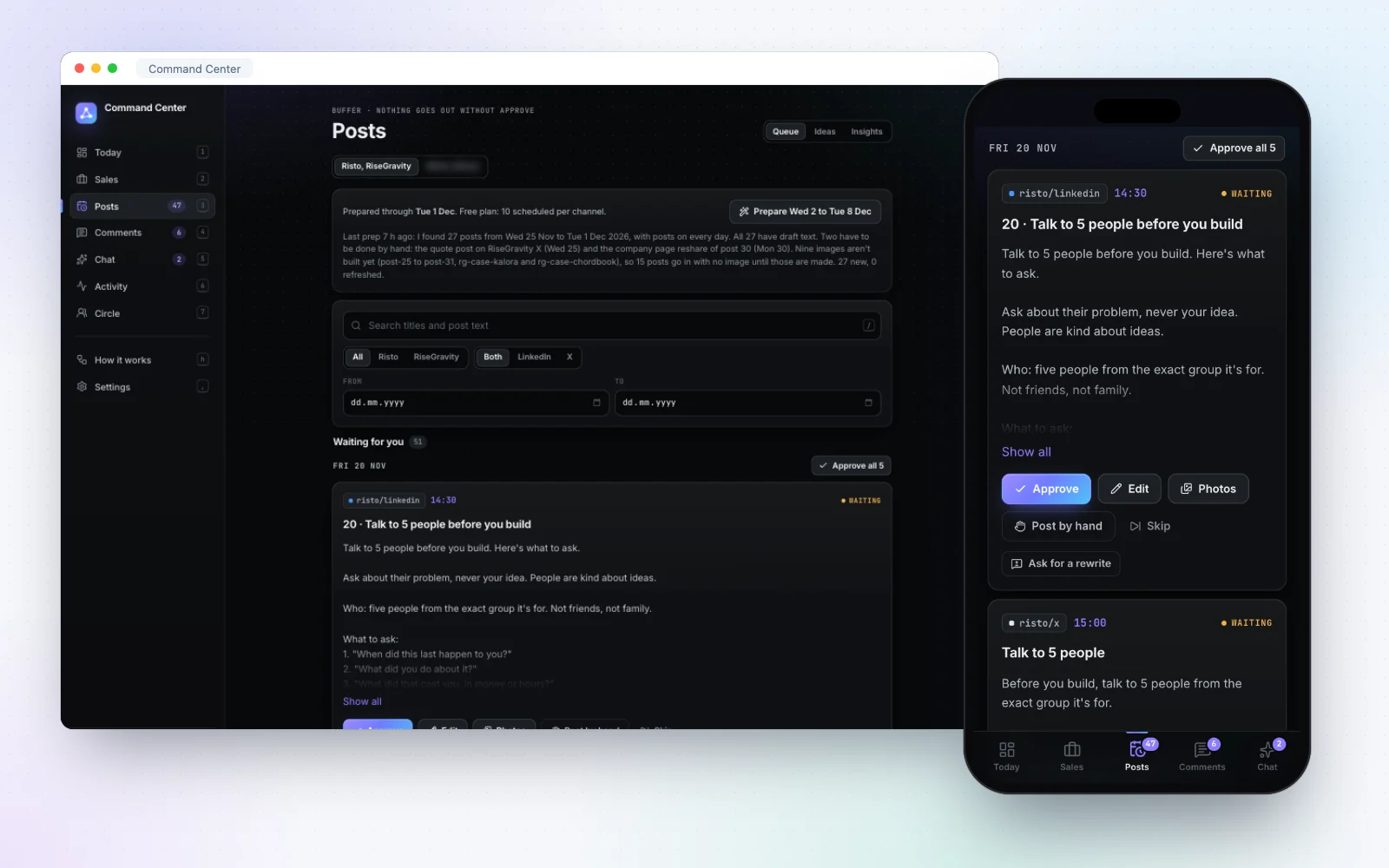
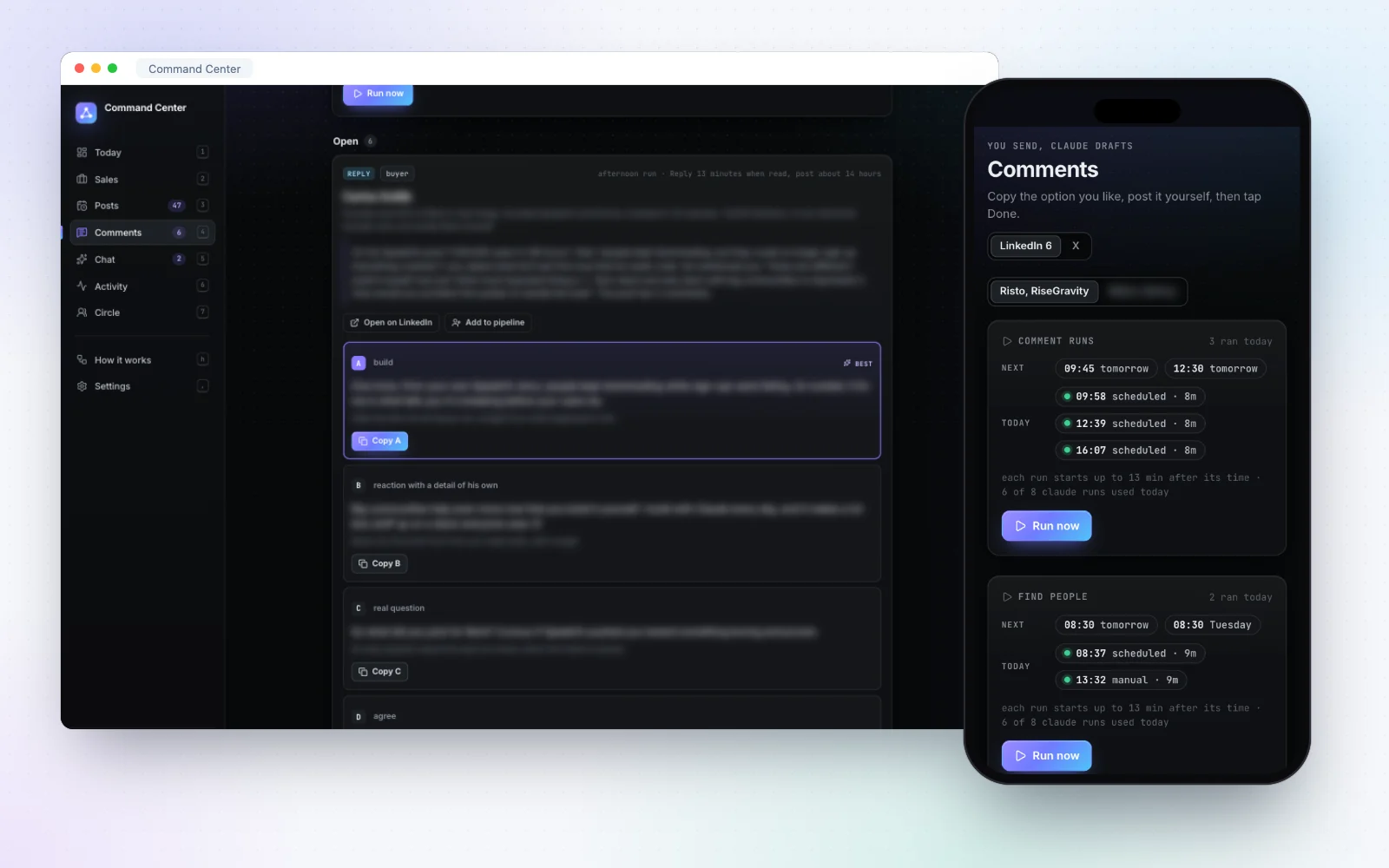
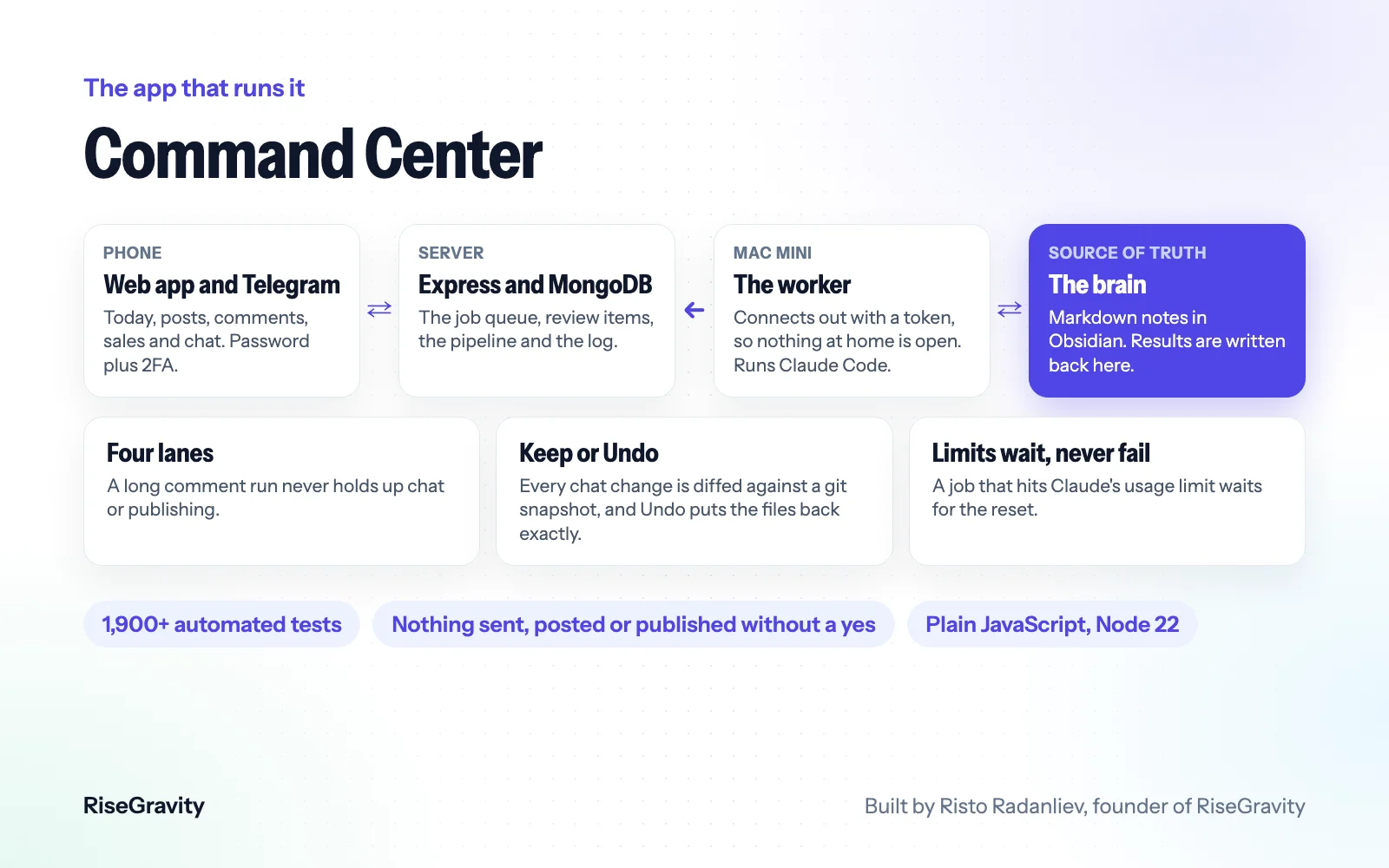
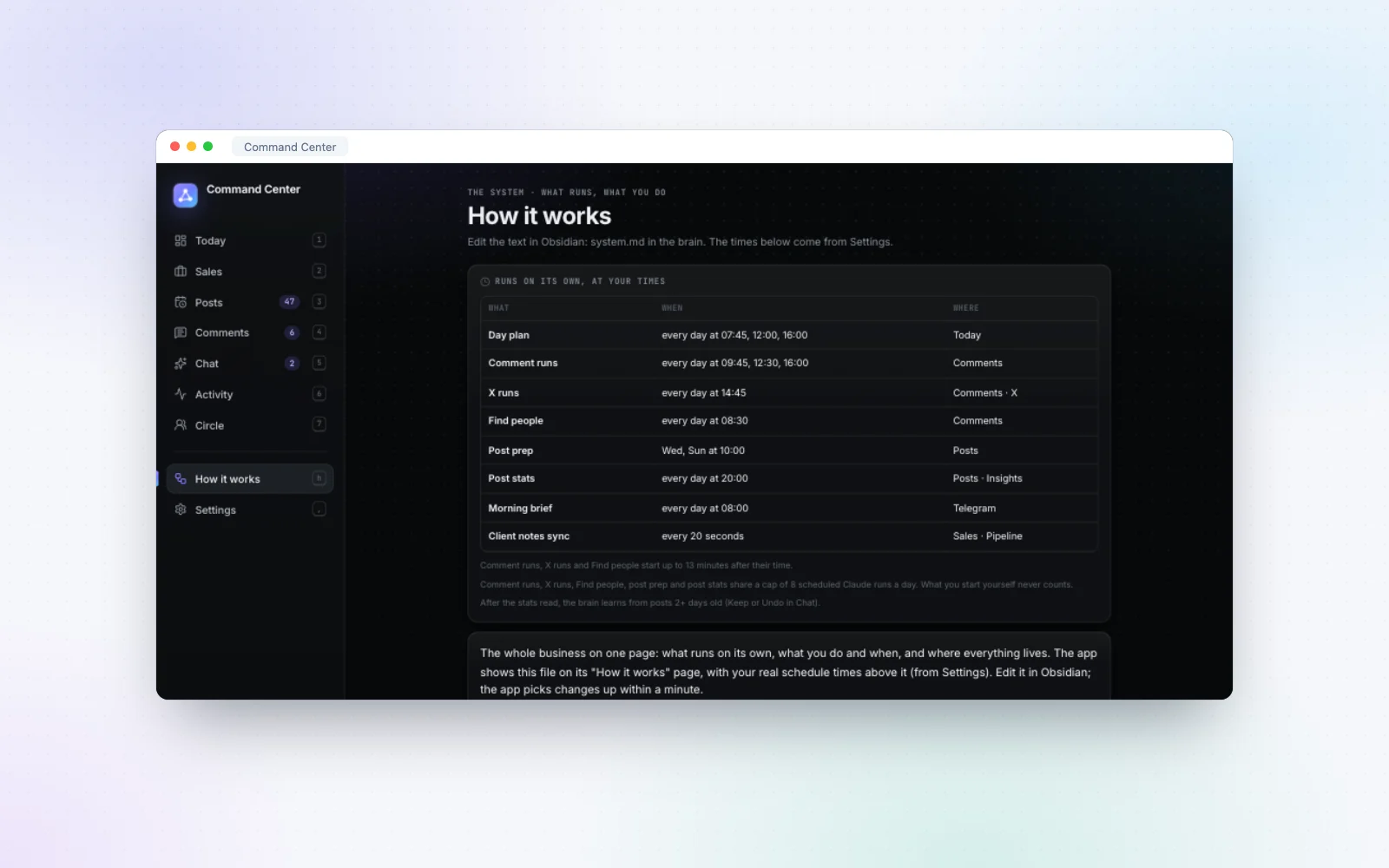
The screens on this page are from the real system, the Command Center, which runs RiseGravity's own accounts. Other people's names and posts, and the replies drafted for them, are blurred. The two diagrams show how the parts fit together.
Overview
RiseGravity sells through its founder's name first. Founders read Risto's posts, check the company page, and only then trust "we". That means four accounts with one goal: Risto on LinkedIn and X, and RiseGravity on LinkedIn and X. Each has its own job and its own rhythm, and none of them can sound like the others or like a bot.
The LinkedIn Engine works in a fixed order. It starts by interviewing the owner: the story, what he could teach, what he wants to teach, what he could sell. From that it sets the positioning, three topics and a lead magnet, then writes the profile, and only then the weekly posts and comments. Every post, comment and profile goes through the same check before anyone sees it: plain words, no invented facts, no filler.
How a post goes out
One calendar file a month holds every post on every account, with its date, its time and its image. Post prep reads it and has Claude draft the next 7 days in the right voice for each account. The app then checks each text word for word against its draft, so nothing that was not written and read gets through.
Nothing is scheduled until the founder approves that post in the app, one post at a time. Only then does it go to Buffer, which publishes it at its time. Post images are uploaded under names made from their content, so Buffer always fetches the right file.
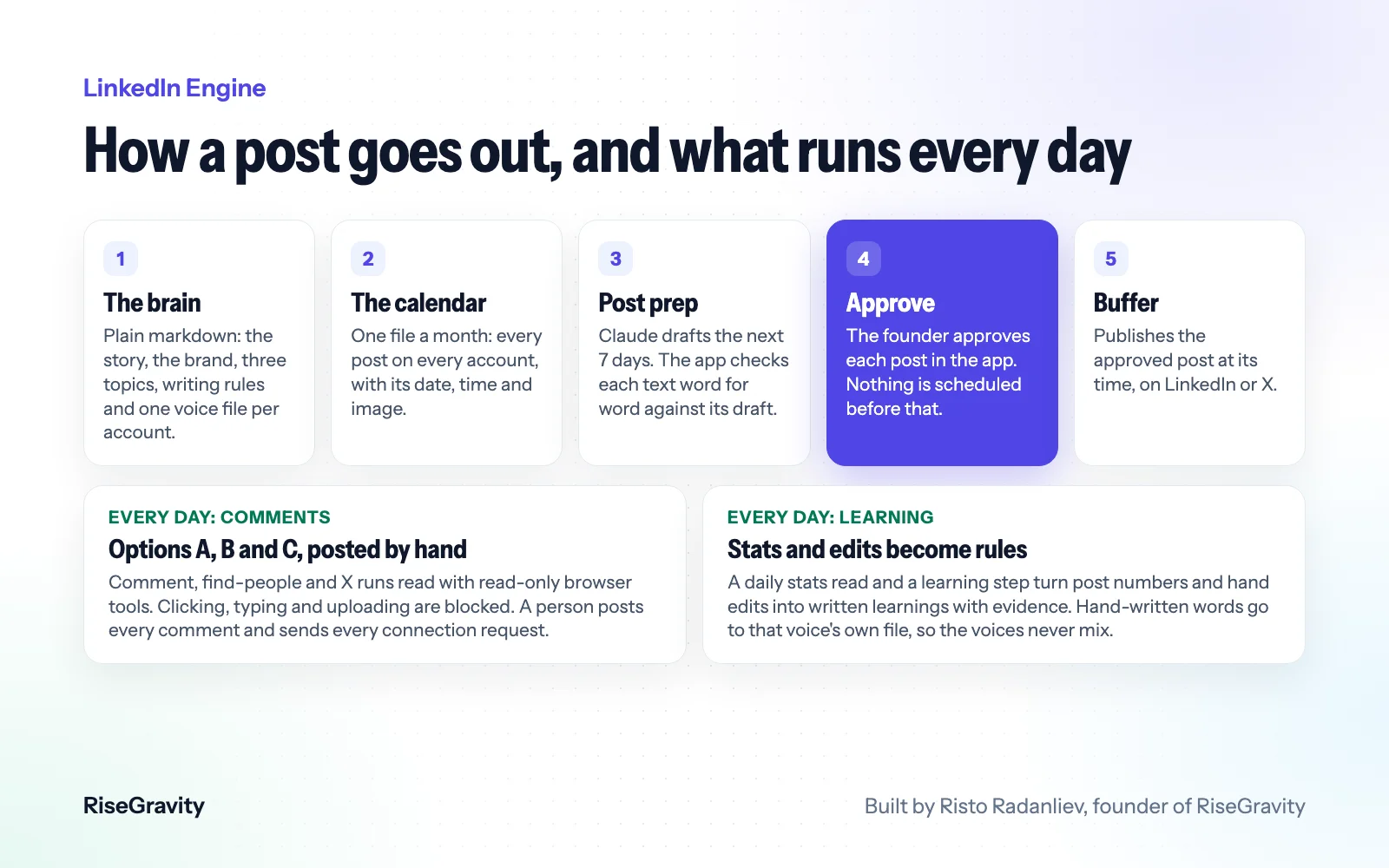
Comments, posted by hand
On LinkedIn, the comments are where buyers notice you. Several times a day a comment run reads LinkedIn in a browser and returns options A, B and C for each post worth answering. A find-people run suggests who to connect with, and an X run finds posts to reply to and accounts to follow.
All of these runs only read. Their browser tools for clicking, typing and uploading are blocked. A person picks an option, posts every comment and sends every connection request by hand, so the accounts stay human.
A system that learns from its own posts
Every day the app reads the numbers on each post. A learning step looks at posts at least two days old and writes down what worked, with the evidence next to it. The next drafts read those learnings before they start.
What a person writes by hand teaches the voice too. A comment written as "my own version", or a post whose text was changed before approval, goes into that voice's own file, next to what had been drafted. There is one file per voice, so the founder's voice and the company's voice never mix.
The Command Center: the app that runs it
The Command Center is a phone-first web app and a Telegram bot. It shows the day's moves, the posts waiting for approval, the comment options, the sales pipeline and a chat. It runs on a server with Express and MongoDB, behind a password and two-factor login.
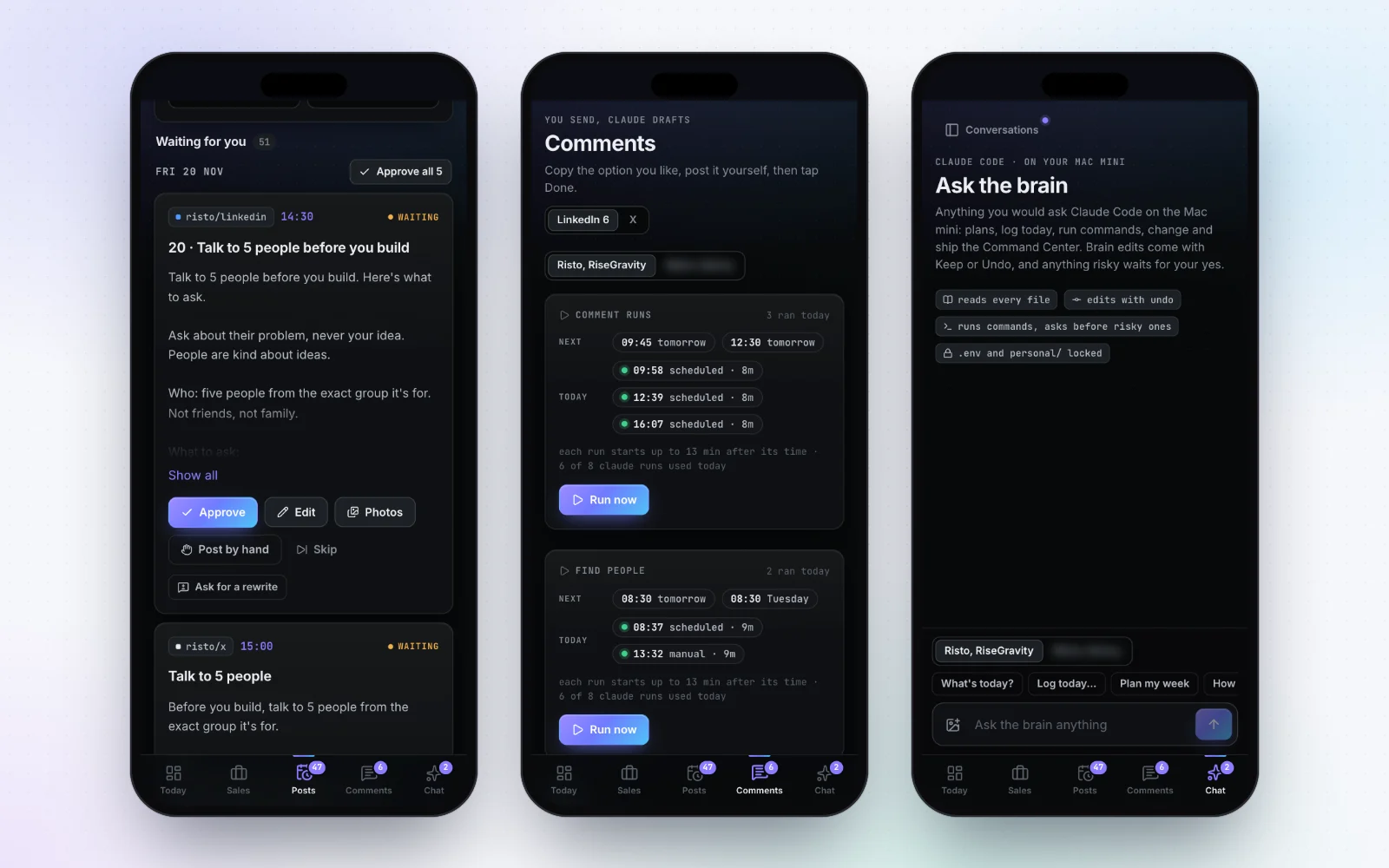
The AI work happens on a Mac mini. Its worker connects out to the server with a token, so nothing at home is open to the internet, and runs Claude Code in the folder of notes. Jobs run in four separate lanes, so a long comment run never holds up the chat or publishing. A job that runs into Claude's usage limit waits for the reset and then carries on; it never fails.
The chat can change the notes, and every change comes with Keep or Undo: each reply's changes are compared against a git snapshot, and Undo puts the files back exactly. Tasks close themselves in plain code when the work is done in the app, with no AI run. And the rule that never bends: nothing is sent, posted or published without the founder's yes.
The brain stays the source of truth
Everything the system knows lives in a second brain of plain markdown notes in Obsidian: the offers, the proof, the voice, the brand, the calendar, the client notes and the decisions. Claude reads it on every run, and every result is written back into it. The app keeps the queue, the review items and the log, and its sales pipeline stays in sync with the client notes in both directions.
Because the notes are plain files in git, a person can read and edit all of it, and any change can be taken back.
Architecture & tech
- Web app: React and Vite, phone first
- Server: Node.js 22, Express and MongoDB, in plain JavaScript, under PM2 behind Nginx
- Worker: a Node.js service on a Mac mini that connects out with a token and runs Claude Code
- Browser runs: Claude in Chrome with read-only tools
- Publishing: Buffer, after approval
- Notices: a Telegram bot
- Notes: markdown in Obsidian, kept in git
- Tests: more than 1,900 automated tests
What made it work
Two decisions carried this system. First, the notes are the truth, and the app is only the hands: everything Claude knows is in files a person can read, edit and take back, so the system never drifts from what the founder actually thinks. Second, AI drafts and a person decides: every post waits for approval, every comment is posted by hand, and the browser runs can only read. The result is a content engine that keeps four accounts moving every day and still sounds like the people behind them.
Deliverables
- The LinkedIn Engine: story, brand, three topics, a voice file per account, writing rules, a scorecard and the check every post passes
- A monthly content calendar for four accounts on LinkedIn and X
- Post prep: Claude drafts the next 7 days, each text checked word for word against its draft
- Approval in the app before any post reaches Buffer
- Comment, find-people and X runs that only read and return options to post by hand
- Daily post stats and a learning step that writes learnings with evidence
- One file of hand-written words per voice, read by every run in that voice
- The Command Center: a phone-first web app and a Telegram bot, with a chat that offers Keep or Undo
- A Mac mini worker with four lanes, and jobs that wait out usage limits instead of failing